
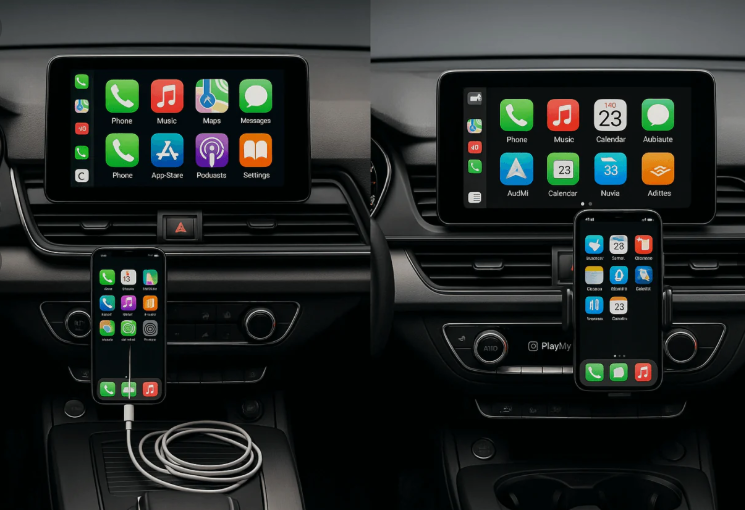
Wireless Apple CarPlay vs Wired — Is It Worth the Upgrade in 2026?
Wireless Apple CarPlay vs Wired
If you’ve recently installed an aftermarket head unit or you’re driving a car with factory wired CarPlay, there’s a good chance the question has crossed your mind: is wireless Apple CarPlay actually worth it, or is plugging in still the smarter move? In 2026, the gap between the two has never been smaller — but it hasn’t completely closed. This guide breaks down everything you need to know so you can make the right call for your car, your iPhone, and your budget.
What Is Wireless Apple CarPlay — and How Is It Different?
Both wired and wireless Apple CarPlay deliver the same core interface. You get the same navigation, the same Spotify integration, the same Siri voice control, and the same messaging apps displayed on your dashboard screen. The difference is entirely in how the connection is made.
Wired CarPlay connects your iPhone to the head unit via a USB-A or USB-C cable. The moment you plug in, the connection is established and your phone begins charging. Wireless CarPlay, by contrast, uses a two-stage handshake: Bluetooth handles the initial pairing, then the system switches to a 5GHz Wi-Fi Direct link for the actual data stream. The result is a completely cable-free connection that activates automatically the moment you get in the car.
By 2026, wireless Apple CarPlay has become the standard expectation on new aftermarket head units from Pioneer, Alpine, Sony, and Kenwood. Demand for wireless CarPlay upgrades in the UK has risen by 65% since January 2024, making it one of the most searched car audio upgrade topics of the year.
The Real Performance Difference in 2026
The biggest concern most drivers have when considering wireless Apple CarPlay is performance — specifically latency and audio quality. Here is what the actual data says.
Latency
Wireless CarPlay introduces approximately 25–50 milliseconds of additional latency compared to a wired connection. In practical terms, this is completely imperceptible during navigation and hands-free calls. You may notice a brief 1–2 second delay when skipping songs or switching apps, but this is a deliberate design choice by Apple to ensure audio stream continuity — it is not a hardware defect or a flaw in your adapter.
High-quality adapters and head units using the 5.8GHz frequency band have significantly closed this gap in 2026. The older 2.4GHz band, which caused connection drops and stuttering in urban environments with heavy wireless interference, has largely been replaced as the industry standard.
Audio Quality
Wired and wireless CarPlay both use the AAC 256 kbps codec. Wireless CarPlay transmits audio over Wi-Fi Direct, which carries 10 times more bandwidth than the audio stream actually requires. In blind tests carried out in 2026 — including participants who were professional audio engineers — no meaningful difference was detected between wired and wireless CarPlay audio output. For drivers with upgraded car audio systems including external amplifiers and component speakers, the CarPlay connection itself is not the limiting factor in sound quality.
Where wired CarPlay does hold a genuine advantage is for audiophiles streaming lossless audio via Apple Music or Tidal. A physical USB connection supports the highest bitrates without any compression in transmission, which matters if your system is built to resolve that level of detail.
Wireless CarPlay: The Case For Upgrading
Convenience That Adds Up Every Day
The single most compelling argument for wireless Apple CarPlay is the daily friction it eliminates. You no longer need to locate a cable, plug in while navigating, or reconnect after stepping out at a petrol station or car park. Your iPhone pairs automatically as you settle into the driver’s seat. On short daily commutes and multi-stop driving — the kind of usage pattern most UK drivers have — this convenience compounds quickly.
A Cleaner Dashboard
A wired setup requires a cable running from the USB port to wherever your phone is mounted or resting. In most cars this creates clutter across the centre console that affects both the aesthetics and the usability of the space. Wireless CarPlay eliminates this entirely, which is particularly relevant if you’ve invested in a clean aftermarket installation or a high-end head unit.
Phone Flexibility
With a wired connection, your iPhone is tethered by the length of the cable. This becomes a genuine nuisance in urban driving when you need to use your phone to pay for parking, confirm a delivery, or hand it to a passenger. Wireless CarPlay means your phone can sit in your pocket, your bag, or a wireless charging pad — wherever you want it.
Wired CarPlay: When It Still Makes Sense
Battery Management on Long Drives
Wireless CarPlay consumes more power because your iPhone’s Wi-Fi and Bluetooth radios are active continuously throughout your journey. Without a charging cable, your battery will drain during extended use. If you regularly make long motorway journeys using GPS navigation simultaneously, a wired connection — which charges your phone throughout — is the more practical choice unless you have a wireless charging pad installed in the car.
Maximum Connection Stability
Wired CarPlay operates over a physical data pathway that is essentially immune to wireless interference. In environments with dense Wi-Fi congestion — busy car parks, urban centres, festival sites — wireless connections can occasionally drop or require manual reconnection. A wired connection has no such vulnerability.
Budget-Conscious Builds
If your primary goal is audio quality and reliable CarPlay functionality, a wired setup costs nothing extra if your current head unit already supports it. Wireless upgrades — whether via an aftermarket head unit or a dedicated adapter — come with an additional cost that is not always justified for every driver.
How to Add Wireless Apple CarPlay to Your Car in 2026
There are three practical routes depending on your current setup.
Wireless adapter dongle — If your car already has factory-fitted wired CarPlay, a compact USB dongle such as the Carlinkit 5.0 or CRUX ACP-WLX plugs directly into your existing USB port and converts the system to wireless. UK retail prices start from around £60. These adapters are compatible with over 98% of UK models built since 2016, including Ford, Volkswagen, and BMW. Crucially, these devices only add wireless functionality to existing CarPlay systems — they cannot add CarPlay to a head unit that has never supported it.
Aftermarket head unit — If your car has no CarPlay at all, replacing the factory stereo with an aftermarket double DIN head unit from Pioneer or Kenwood is the cleanest upgrade path. Units with native wireless CarPlay start from around £250–£329 in the UK, with professional fitting adding to the total depending on vehicle complexity.
OEM retrofit modules — For drivers wanting to retain their factory screen, vehicle-specific CarPlay retrofit modules from brands such as Beat-Sonic allow seamless integration without replacing the entire head unit. These are particularly relevant for Lexus, Toyota, BMW, and Porsche owners.
Wireless Apple CarPlay vs Wired — The Verdict for 2026
For the majority of UK drivers, wireless Apple CarPlay is worth the upgrade in 2026. The audio quality difference is negligible for real-world use, the latency gap has been reduced to an imperceptible level by current 5GHz technology, and the daily convenience of automatic, cable-free connection is a genuine quality-of-life improvement that adds up across hundreds of journeys.


